All About Ultra Chic Porcelain Slip: The Questions You Meant to Ask (But Forgot)
- Marina - AllforDoll

- Mar 14
- 9 min read
Updated: Apr 9
Renowned worldwide for its superior quality, Ultra Chic Porcelain Slip is considered by artists across the globe to be the finest choice for dollmaking and beyond. The main feature of Ultra Chic porcelain slip is that it has a completely natural composition. No chemicals – only organic materials. The uniqueness of Ultra Chic slip lies in the fact that you receive it already in liquid form, with colors pre-mixed according to the shade you selected at the time of purchase. You simply need to stir it well, and it is instantly ready for use.

This premium porcelain slip never separates in the bottle, making it incredibly easy to pour, release, and clean. Seam removal is effortless, and the flawless surface finish makes it ideal for China painting. Firing requires little to no propping, saving you time and effort in the kiln. Whether you're creating dolls or fine porcelain art, Ultra Chic truly sets the standard.


So, let's start with frequently asked questions.
“Is it true that porcelain can not be shipped in the winter, because of the fear of freezing?”
Ultra Chic and China Silk are pure, organic porcelain without any chemicals. Therefore, just like ancient Chinese porcelain, it can be frozen. Once thawed it pours and fires just like it did before it was frozen. Other porcelains can not be shipped in the winter.
“Why was I told that I can’t reclaim porcelain? It would cut my cost down”
This is an easy one. YOU CAN! Ultra Chic Porcelain Slip can be reclaimed. The problem is how you reclaim it and how to pour it afterwards. Save your spares and broken pieces and don’t reclaim them until they are dry. That’s the secret. Cover them with water and allow them to sit overnight. The porcelain will reclaim itself and sink to the bottom. In the morning, dump off the water float, stir and strain. This reclaim can then be added to new porcelain at a rate no greater than 25% reclaim to 75% new. This keeps the porcelain balanced and yet allows you to save money.


“Can I sculpt, for example, flowers with Ultra Chic or China Silk?”
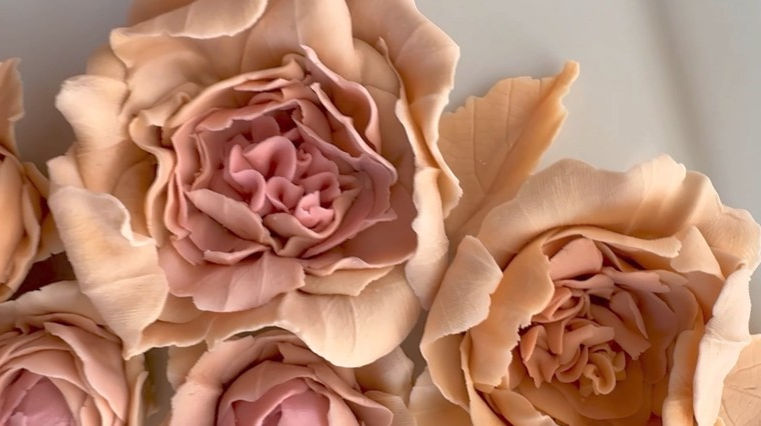
Ultra Chic nor China Silk contain any harmful deflocculants. Especially lithium. They are totally organic slips. You can easily make hand made flowers from the collar or spare when you cast your piece. You can leave a jar open until it thickens then drain the water. Or you can pour slip on the outside of a mold like a pancake. The mold will pull the excess water and you will have clay.


"I purchase your Magnolia White slip and I really enjoy working with it, but there is one nuance: The Magnolia White has a LOT of shrinkage. I work with specific antique reproductions. That means sometimes the heads I pour in Magnolia White shrink so much that the resin shoulder plate with the Dollspart French Fashion body is too big for the neck socket of the porcelain heads. My favorite head to make for the Dollspart body is the Huret head, and it shrinks quite a lot".
Shrinkage. Porcelain shrinks either 15% or 17% depending on the brand. Ultra Chic and China Silk shrink 17%, and I understand that this is problematic for you. For antique artists who are now making leather or cloth bodies, it works just fine.
What is happening in the antique doll industry is that they used to use composition bodies and then attach porcelain heads, etc., to that composition body. Composition is an acrylic and paper mâché body and hard to work with. The companies that made the composition bodies have all gone out of business, so Dolls Parts in New York started making resin ones in China, and they add their porcelain heads to those.
The bodies unfortunately were made specifically for Seeley slip, which shrinks only 15%. So heads from Ultra Chic will not fit those resin bodies.
Perhaps the only thing that could be done with the shrinkage is to make the slip (liquid porcelain) with less water so that it is really thick; however, that would be costly because modern people do not want it that thick.
What I can suggest to you: If you leave the jar open for a week or so with the lid off, then the slip will thicken (some water evaporates), and then it will not shrink as much.
“I have a piece that even in China Silk/Ultra Chic, because of the way it is sculpted, leans forward. What can I do?”
Better sit down for this one. Tilt the shelf! You heard right. Lay one shelf on top of another. Then use two small 1/ 2” supports and place these between the shelves in the front only, thereby tilting the shelf backwards. By doing this, when the piece tries to fall forward, the gravity of the tilted shelf will keep it upright. This is a secret of the fancy European studios with their dramatic pieces that fire with glaze on them all in one firing.
“What do I put on my shelves so that the porcelain doesn’t crack during the firing?”
Again this is an easy one. Alumina Hydrate. This is one ingredient in “Kiln Wash”. Unfortunately the other ingredient is Kaolin which causes the mixture to stick to your shelf and eventually flake off and cause an uneven surface for firing. You can mix Alumina Hydrate with water and brush it on your shelf, or simply sprinkle it on your shelf. Either way it can be easily brushed off after the firing if you desire, leaving a new shelf again.
On some fairly dark colors, after high firing, you may notice small dark specks on the doll parts, which is especially undesirable if they appear on the doll’s face.
Dark spots in darker colors are easy to fix.
When I make a colorless slip base, I always strain it through a 120 mesh screen so that it is clean and ready to use. Only after that do I add a specific color formula. It seems that some of the companies where I purchase specialized pigments are having an issue with their tints for certain colors. Their pigments sometimes contain small crystalline particles that do not fully dissolve during mixing. Since their products are not made specifically for doll-making, and you are working with doll faces—where even tiny dark specks are undesirable—I would recommend the following:
You can take a 150 mesh screen and strain the slip through it, and you will be able to see the dark particles on the screen. Also, if you use silica sand during high firing, try to sift it quite frequently.
This is what all artists do who purchase my slip for creating BJD dolls. When I produce slip, I make it for general use—for dolls and for other art pieces. If your work requires a high level of detail, it is best to take extra precautions. In this case, that means straining it again more thoroughly.
“I have a piece that always cracks inside the mold in the same place before I can get it out. Any ideas?”
Certainly. Porcelain begins to shrink inside the mold and with some pieces can cause cracking. Spray this area of the mold with water to slow down the shrinkage. If necessary you may even paint it with a brush and water.
“I have a piece that is dry and I can now see a crack where I added on an arm. Please help!”
This is actually pretty easy to fix. First use a sharp scalpel and widen the crack a bit. Yes, widen it. Then use a brush, water and porcelain. First use water only and really dampen the cracked area and around that area. Dip the brush in water and then porcelain. Flood the crack with very watery porcelain several times. This insures the fact that it has gone all the way through. It should fire fine.
“I keep forgetting which cones are used to fire specific colors”.
On the label attached to the slip jar, the cone number for firing that particular color is always indicated.

“The porcelain I am using is supposed to be prop- free but some pieces still sag. Why?”
Sometimes sagging is caused by the liquidity of your porcelain and not the porcelain itself. In other words, thin your porcelain to the consistency of light cream. If you pour with the liquid too heavy you can cause what is called “Liquid Memory”. This means you cause a piece to sag when it normally would not. Thin your porcelain more and try the piece again.
“My porcelain is never as white or as translucent at the manufacturer’s samples are. Why is this?”
This could be one of two reasons. You could be firing too fast, or your kiln is under firing. “The slower the firing, the whiter the porcelain” is always a good rule of thumb. Also you should check your kiln to make sure that it is firing correctly. You can always fire a cone hotter to achieve more translucency. Or you can refire to the same cone and force for maturity as well. An extreme slow firing will create the whitest porcelain possible.
“Must I use special molds for porcelain?”
No. You can wipe the mold out with a sponge and water or vinegar water. Then pour a “Flash Casting”. This casting will pull the earthenware clays out of the mold. Discard this casting. Some molds, depending on how often it was cast in earthenware, or another porcelain that contains ball clay, might take several castings to clean the mold out.
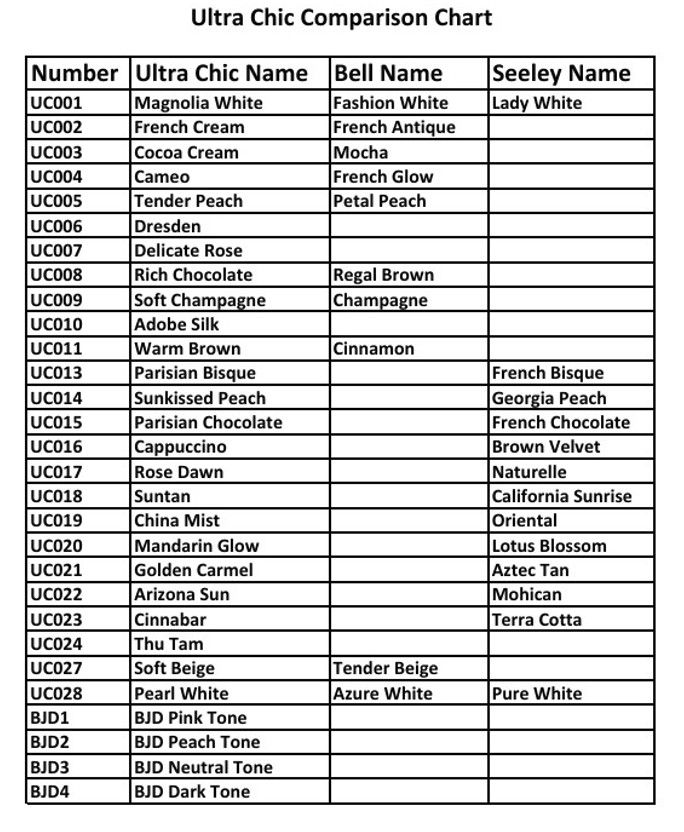
"I decided to switch to your porcelain slip because it is organic and much easier and better to use, but I would like to keep the colors I have been using for my dolls. How can I find matching colors?"
Yes, of course. There is an Ultra Chic Comparison Chart.
Basics of Pouring Ultra Chic (Summary)
Before pouring, the porcelain slip must be tested. Open the container and stir thoroughly to the bottom with the wooden spoon. Push the spoon to the bottom and release it. If the slip is at the correct consistency, the spoon should bounce back out within one or two seconds. If it does not, the slip is too thick. In that case, add a small amount of water and mix thoroughly again. Continue adjusting gradually until the slip reaches the consistency of light cream. It is important to add water slowly to avoid making the mixture too thin.
Place a metal strainer over an empty pouring pitcher and strain the amount of slip needed for casting. Avoid pouring too many molds at the same time, since Ultra Chic sets and releases quickly. Keep the strainer in a bowl of water so that it does not dry out.
Make sure the mold bands are tight before pouring. Pour the slip gently and steadily into the center of the mold until it is full. As the plaster mold absorbs water from the slip, the level of slip will drop, so add a small amount more to keep it near the top. Watch the wall thickness carefully, and once the desired thickness is reached, pour the excess slip back into the pitcher. Ultra Chic can release even when cast very thin, which makes it suitable for delicate items such as ornaments.
After about five minutes, use the trimming knife to cut the collar around the pour hole. The material is plastic enough to be trimmed while still in the mold. Save the trimmed collars and any broken pieces in a container so they can be reclaimed later. Remove the mold bands and place the mold with the seam positioned horizontally. Allow it to sit for several minutes, longer for larger pieces. When the top half of the mold lifts easily without resistance, it can be removed. Leave the casting in the bottom half of the mold until it stiffens enough to be removed safely. The piece should never be forced out, as this may cause cracking.
When pouring molds with very small pour holes, the slip may need to be slightly thinner to flow properly. For pieces with additional parts, such as figurines with arms or other attachments, both the main piece and the add-on parts should sit for about thirty minutes before assembly. The pieces can then be joined using slip, and the joint can be cleaned gently with a soft damp brush. If hairline cracks appear after drying, the parts were likely joined too late.
Leftover collars and broken pieces can be reclaimed by placing them in a container and filling it with water. After soaking overnight, the porcelain will settle to the bottom while excess water floats on top. Pour off the extra water, stir the mixture, and strain it. Reclaimed porcelain can be mixed with new slip in a ratio of about twenty-five percent reclaim to seventy-five percent new material without affecting performance. Using pure reclaimed material will cause the piece to shrink more during firing.
When stirring the slip, avoid mixing too quickly because this can introduce air bubbles. If bubbles appear, allow the slip to sit until they rise and disappear; tapping the container can help speed this process. Ultra Chic slip naturally releases air quickly and does not separate in the liquid. It is also not sensitive to temperature and can tolerate freezing or high heat without damaging its properties.
If the porcelain sticks to the mold, it may be due to residue from other slips containing ball clay that can clog the pores of the plaster. The mold can be cleaned by wiping it with a mixture of half water and half distilled vinegar, though this method is better suited to simple molds without delicate details. Another option is to pour a very thick casting, about a quarter inch thick, which helps pull residue from the plaster. A third traditional method is to lightly mist the inside of the mold with distilled vinegar before pouring.
As you know, the porcelain slips Ultra Chic and China Silk can be used not only for making dolls but also for creating other works of art.
Please don’t hesitate to ask any questions – I will be happy to answer them - info@allfordoll.com
You can purchase porcelain slip in both pints and gallons directly from my website - allfordoll.com => buy porcelain slip...
You can also order sample chips in any color you need.
Ultra Chic


Wishing you great success in your creative endeavors! Marina-AllforDoll.


Comments